Piqo Analytics Review: A Refreshingly Simple Alternative to Traditional Web Analytics
Looking for a privacy-friendly alternative to Google Analytics? Piqo Analytics offers real-time traffic monitoring, Stripe revenue attribution, visitor journey tracking, Google Search Console integration, and affiliate analytics in one dashboard. Read our in-depth review to discover its strengths, weaknesses, pricing, and who should consider using it.
In a market crowded with complex analytics platforms, Piqo Analytics takes a different approach: simplicity. Instead of overwhelming users with endless dashboards, integrations, and configuration options, Piqo aims to provide privacy-friendly analytics, revenue attribution, and visitor insights through a single lightweight platform.
After exploring the product, here's an objective look at what Piqo offers, where it stands out, and where it still has room to grow.

What is Piqo Analytics?
Piqo Analytics is a privacy-first web analytics platform designed for startups, indie makers, agencies, and small businesses. The product combines website traffic analytics, conversion tracking, revenue attribution, Google Search Console data, and affiliate tracking into one dashboard.
The installation process is intentionally minimal. Users simply add a lightweight tracking script to their website, register their domain, and begin collecting analytics data without SDKs or complicated setup procedures.
The platform positions itself as an alternative to using multiple tools such as Google Analytics, Search Console, Stripe dashboards, and affiliate tracking systems separately.
Key Features
1. Real-Time Visitor Analytics
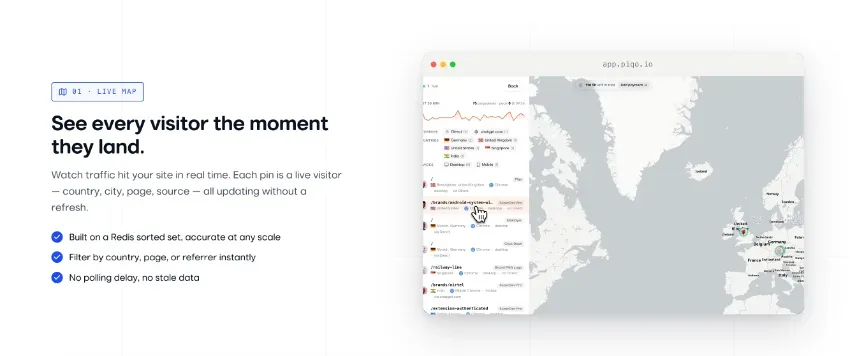
One of Piqo's most visually appealing features is its live visitor map. Traffic appears in real time, showing visitor locations, pages viewed, and traffic sources without requiring page refreshes.
For founders and marketers who enjoy monitoring traffic activity as it happens, this feature adds a level of engagement that many analytics platforms hide behind premium plans.
2. Revenue Attribution
Piqo integrates directly with Stripe and connects revenue back to traffic sources.
Rather than simply showing pageviews and conversions, the platform attempts to answer a more valuable question:
Which marketing channels are actually generating revenue?
For SaaS businesses and subscription products, this can significantly reduce the effort needed to connect acquisition and monetization data.
3. Visitor Journey Tracking
The visitor journey feature provides a complete timeline of a user's interactions, including:
Landing pages
Navigation paths
Click events
Referral sources
Geographic information
Unlike traditional session replay tools, Piqo focuses on event timelines rather than recording full user sessions, which helps maintain a stronger privacy posture.
4. Google Search Console Integration
Search performance data is integrated directly into the main analytics dashboard.
This eliminates the need to switch between multiple tabs and tools when analyzing:
Search queries
Landing pages
Geographic performance
Device breakdowns
For content-driven businesses and SEO-focused teams, this integration adds meaningful convenience.
5. Affiliate Tracking
An unexpected addition is the built-in affiliate management system.
Users can generate referral links, monitor conversions, calculate commissions, and even provide partners with dedicated dashboards.
Many competing analytics tools require separate software for this functionality.
What We Like
Extremely Simple Setup
The onboarding experience is one of Piqo's strongest selling points.
Many analytics platforms require SDKs, event schemas, tag managers, and custom implementations. Piqo intentionally reduces this complexity to a single script installation.
Affordable Pricing
At $19/month or $69/year (early supporter pricing), Piqo is significantly cheaper than many analytics solutions that charge based on event volume or advanced features.
The pricing model is straightforward and avoids the complicated tier structures common in the analytics industry.
Privacy-Friendly Approach
Piqo emphasizes:
No fingerprinting
No third-party ad networks
No local storage usage
Privacy-oriented visitor identification
This approach will appeal to businesses seeking analytics solutions that are easier to align with privacy expectations.
Strong Feature Consolidation
One of Piqo's biggest advantages is reducing tool fragmentation.
Instead of checking analytics, revenue, search performance, and affiliate activity across multiple dashboards, users can view everything in a unified interface.
Areas for Improvement
Relatively New Product
Piqo appears to be an early-stage product compared to established players such as Google Analytics, Plausible, or Fathom.
While the feature set is impressive, long-term reliability, ecosystem maturity, and community adoption remain areas to watch.
Limited Advanced Analytics
Businesses requiring:
Custom reporting
Advanced segmentation
Data warehousing
Enterprise-grade analytics workflows
may find Piqo too lightweight for their needs.
Its strength is simplicity, but that simplicity may come at the expense of deeper analytical capabilities.
Stripe-Centric Revenue Focus
Revenue attribution is currently heavily centered around Stripe integrations.
Although this aligns well with SaaS companies, businesses using more complex payment infrastructures may require additional flexibility.
Who Should Use Piqo?
Piqo is particularly well suited for:
Indie hackers
SaaS founders
Bootstrapped startups
Agencies managing multiple websites
Small businesses looking for simple analytics
Content creators focused on SEO growth
It is less suitable for large enterprises that require advanced business intelligence workflows or extensive custom analytics infrastructure.
Final Verdict
Piqo Analytics is an ambitious attempt to simplify the modern analytics stack. Instead of competing on complexity, it competes on clarity, convenience, and affordability.
The product's strongest differentiator is not any single feature but rather its ability to bring traffic analytics, revenue attribution, search data, and affiliate tracking into one lightweight dashboard.
While it may not yet replace enterprise analytics platforms, it offers a compelling solution for founders and small teams who want actionable insights without spending hours configuring tools.
Rating: 8.6/10
Pros
Very easy setup
Affordable pricing
Real-time analytics
Revenue attribution
Search Console integration
Built-in affiliate tracking
Privacy-friendly approach
Cons
New product with limited market validation
Fewer advanced analytics capabilities
Best suited for startups and SMBs rather than large enterprises
For indie makers and growing SaaS businesses, Piqo is definitely a product worth keeping on the radar.